
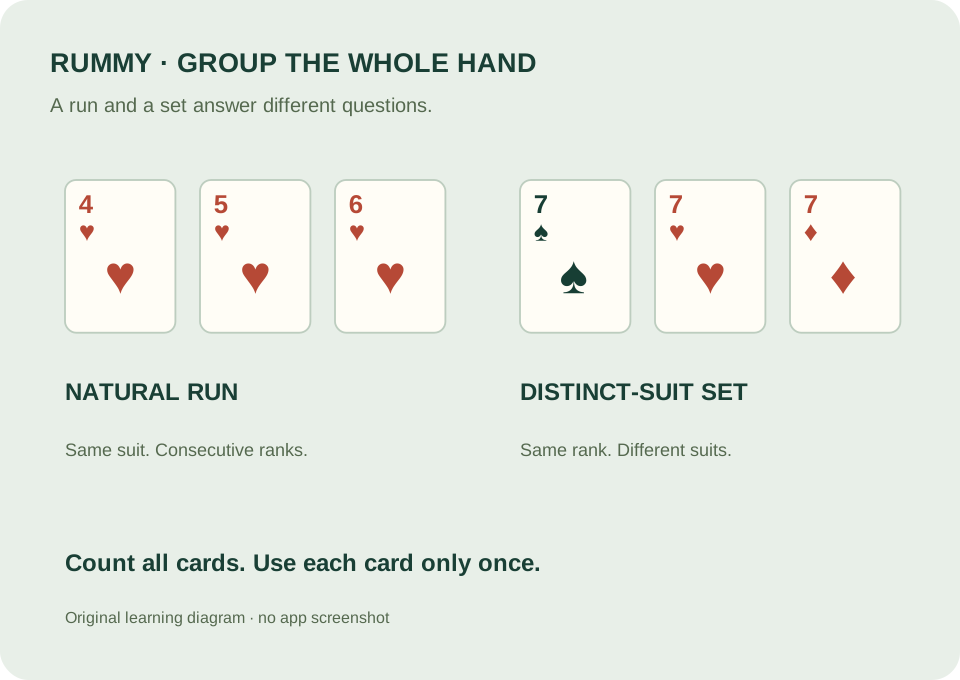
Check three things
| Test | Example that passes | Example that fails |
|---|---|---|
| Same suit | 6♦ 7♦ 8♦ | 6♦ 7♥ 8♦ |
| Consecutive ranks | 10♣ J♣ Q♣ | 10♣ Q♣ K♣ |
| No substituted card | 3♥ 4♥ 5♥ | 3♥ joker-as-4♥ 5♥ |
A longer natural run can also work. A four-card run is not automatically better than a three-card run: its usefulness depends on the rest of your hand.
Repair an original example
Suppose the practice group is 8♠ 9♠ J♠ and the spare card is 10♠. Inserting 10♠ forms 8♠ 9♠ 10♠ J♠. Without that spare card, the group has a gap. Calling the jack “almost a ten” cannot repair it. Write down the missing value before deciding which card might help.
Now replace 10♠ with 10♦. The rank is right but the suit is not. This gives you a simple diagnostic: a missing rank and a wrong suit are two different problems.
A card designated wild can have a natural role
Some published conventions allow a designated wild-rank card to count as itself in an otherwise natural run. Whether that remains pure needs the table’s stated rules. Distinguish using a card at its printed value from substituting it for another value. Do not assume an app’s treatment from a general article.
Count the complete hand
One valid group does not validate a declaration. Use the 13-card example in the Rummy hub and count the groups aloud. No card can serve two groups at the same time in that exercise. If moving a card fixes one run but breaks another, the whole layout is not ready.
A five-minute practice routine
- Write down six candidate groups, with three valid and three invalid.
- For each invalid group, name the exact defect: rank gap, mixed suit or joker substitution.
- Make one repair and state which card you changed.
- Ask another learner to check the complete layout without seeing your notes.