
Start with the bottleneck
Label the groups your hand already contains, then name what is missing. “I need a better hand” is too vague to guide a lesson. “I need one more same-suit run” is an observable target. The pure-sequence guide shows how to find rank and suit gaps.
Compare two uses of the same card
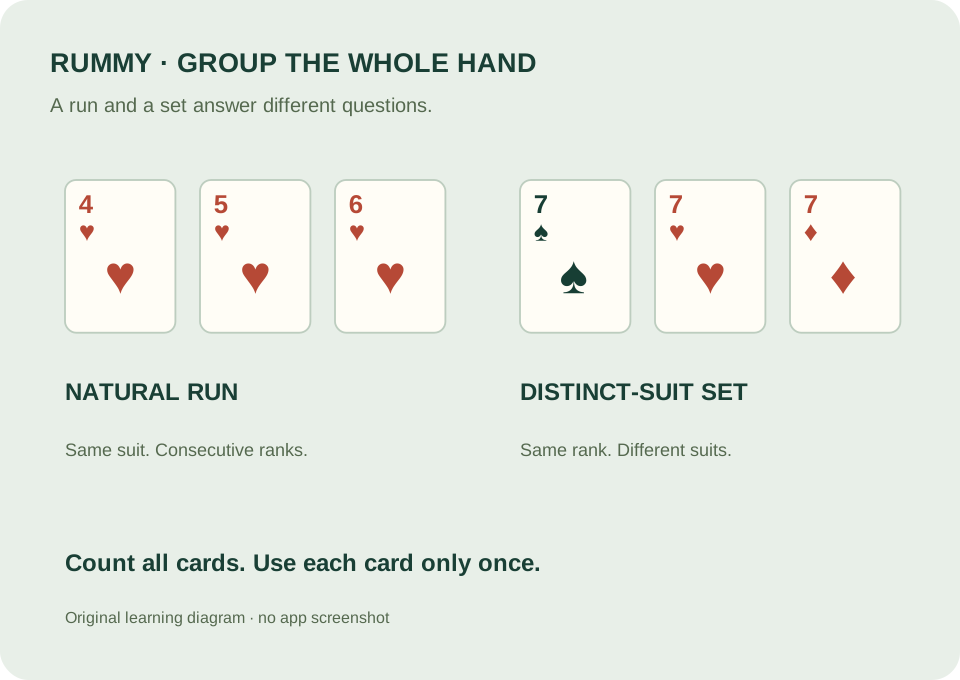
In an exercise containing 5♣ 6♣ 7♣ 7♥ 7♦, the 7♣ could belong to a run or a set, but not both at once. Write two layouts. In Layout A, keep 5♣ 6♣ 7♣ together. In Layout B, group the three sevens. Count what each choice leaves incomplete. The useful lesson is allocation, not an automatic preference for one group.
Use a discard notebook
- Write the visible discard and the reason you considered it relevant.
- Separate what you observed from what you guessed about another hand.
- Do not conclude that an unseen card must appear soon because you have waited for it.
- After the exercise, evaluate the explanation rather than only the outcome.
Keep a declaration checklist
- Count exactly the required number of cards.
- Identify the required sequences under the chosen convention.
- Name the natural sequence and every substituted joker value.
- Ensure that groups do not share a card.
- Check the table-specific declaration and scoring procedure.
Keep the lesson bounded
Choose a fixed number of exercises and stop when they are completed. Using no-cash examples avoids confusing a run of outcomes with evidence that a learning method is profitable. If you are unsure which game suits a lesson, compare Rummy and Ludo or Rummy and Poker.