
Exact counts under the stated convention
| Category | Count | Share of 22,100 |
|---|---|---|
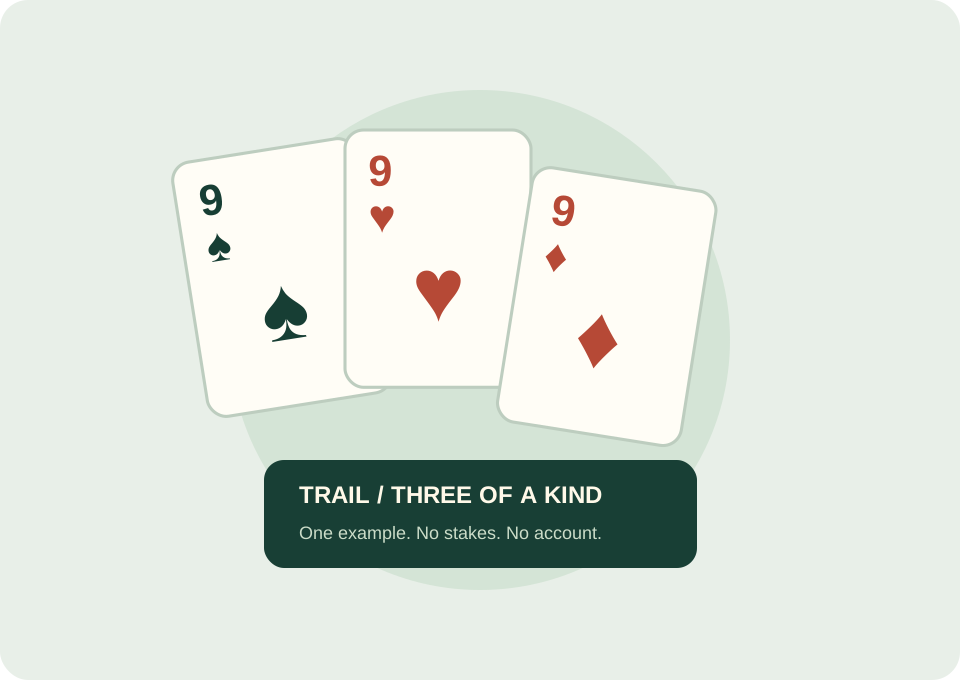
| Trail | 52 | 0.2353% |
| Pure sequence | 48 | 0.2172% |
| Sequence | 720 | 3.2579% |
| Colour | 1,096 | 4.9593% |
| Pair | 3,744 | 16.9412% |
| High card | 16,440 | 74.3891% |
Percentages are rounded independently. Every hand is assigned to its strongest category once; same-suit runs are not counted again as ordinary sequences or colours.
What was enumerated
The calculation selects each set of three distinct cards from one 52-card deck. It recognises A-2-3 and A-K-Q as runs and excludes K-A-2. Changing which recognised ace run ranks highest changes comparisons but not these category counts. The three supported ace settings each produced the same totals.
Reconstruct two counts yourself
For a trail, choose one of 13 ranks and three of the four suits: 13 × 4 = 52. For a pair, choose its rank, two suits, one of the other 12 kicker ranks and its suit: 13 × 6 × 12 × 4 = 3,744. These are independent arithmetic checks on the enumerated totals.
Rarity and rank are different ideas
A pure sequence is slightly rarer than a trail in this classification, while the classic rule still ranks trail higher. Rules define the hierarchy. Frequency alone cannot replace the agreed category order.
What this calculation cannot establish
- The implementation, random-number generator or fairness of a mobile app.
- A probability of winning against a chosen number of opponents with known cards.
- The next shuffled deal or whether a hand is “due”.
- A profitable decision rule or a reason to chase losses.
Try a comparison
Use local practice to compare hand ranks, and the chart to inspect the categories. The enumeration was a code check of our educational evaluator, not an audit of a game publisher.